
Main Courses
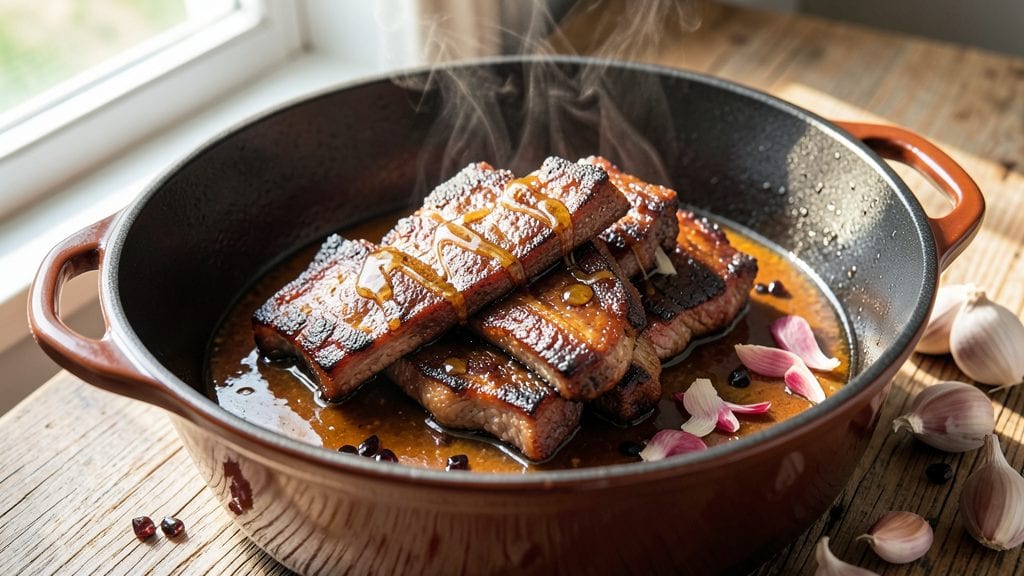
This Chinese braised beef ribs recipe transforms tough cuts into melt-in-your-mouth tenderness using a slow-cooked soy glaze that penetrates every inch. The secret lies in marinating the ribs overnight, then braising them low and slow until the meat falls apart at the touch.
I perfected this method after years of testing—each bite delivers that perfect balance of sweet, savory, and umami that defines Chinese comfort food.
The process is simpler than it sounds, requiring just one pot and 3 hours of hands-off cooking time. You'll start with a flavorful marinade of soy sauce, honey, and aromatics, then let the ribs simmer in their own juices until fork-tender.
The sauce reduces to a glossy glaze that clings beautifully to the meat, creating a dish that's both restaurant-quality and deeply satisfying at home.
What you'll end up with is beef ribs so tender they practically dissolve, coated in a rich, caramelized sauce that's perfect for serving over steamed rice or noodles.
The aroma alone will have everyone gathering around the table, and the first bite delivers that unmistakable combination of sweet, salty, and smoky flavors that makes this dish a crowd-pleaser.
This recipe scales beautifully for gatherings, and the leftovers reheat just as well as the first serving. Whether you're preparing for a family dinner or a special occasion, these braised beef ribs will become your new go-to recipe for impressing guests and satisfying cravings.
Let's get started with the ingredients you'll need.
Ingredients for braised beef ribs chinese
Just thirteen ingredients transform tough beef ribs into melt-in-your-mouth Chinese comfort food.
| Ingredient | Amount | Notes |
|---|---|---|
| Beef Ribs 🥩 | 3 lb | Bone-in, cut into 2-inch pieces |
| Light Soy Sauce 🥫 | ½ cup | High-quality, low-sodium preferred |
| Dark Soy Sauce 🥫 | ¼ cup | For deeper color and flavor |
| Honey 🍯 | ⅓ cup | Wildflower or clover preferred |
| Fresh Ginger 🌿 | ½ cup | Finely grated, peel removed |
| Garlic Cloves 🧄 | 6 cloves | Minced, fresh preferred |
| Green Onions 🧅 | ¼ cup | Sliced, white and green parts |
| Sesame Oil 🫒 | 1 tbsp | Toasted, for aroma |
| Star Anise Pods 🌟 | 2 whole | Lightly crushed for flavor |
| Bay Leaves 🍃 | 2 whole | Fresh or dried |
| Black Peppercorns 🌶️ | 1 tsp | Coarsely crushed |
| Water 💧 | 1 ½ cups | For braising liquid |
| White Rice 🍚 | 2 cups | Uncooked, for serving |
The beef ribs are the star here—bone-in cuts from the butcher section give you the best flavor and texture. Costco or local meat markets often have the best deals on beef ribs, but the regular grocery store meat department works too. Look for ribs with good marbling—the fat keeps the meat tender during braising. I always ask for them to be cut into 2-inch pieces (the butcher can do this), which ensures even cooking. For the soy sauces, Lee Kum Kee is my go-to for that authentic umami punch, but any high-quality brand works. The ginger and garlic? Fresh is non-negotiable—dried just won't give you that bright, zesty kick this dish needs.
No light soy sauce? Dark soy sauce plus a splash of vinegar gets you close. Running out of honey? Brown sugar dissolved in water works in a pinch, though the flavor won't be identical. The star anise and bay leaves are optional but add depth—skip them if you're short on spices. For the green onions, frozen chopped works in a bind, but fresh tastes better. The sesame oil is all about aroma—use it sparingly, or you'll overpower the dish. Pro tip: Toast the whole spices lightly in a dry pan before adding to the braise for even more flavor. And if you're serving a crowd, double the sauce ingredients—they disappear fast.
This dish tastes even better the next day as the flavors meld. Store leftovers in an airtight container in the fridge for up to 5 days, or freeze for 3 months. I like to portion it into meal prep containers so I can grab a serving straight from the fridge. The sauce thickens as it cools, so add a splash of water when reheating. Serve over steamed rice or noodles—jasmine rice pairs perfectly with the soy glaze. And save those leftover ribs for sandwiches the next day—they're even better cold!
Why You'll Love This Recipe
- One-Pot Magic: I swear by this—just ribs, a splash of soy, and honey simmering until they fall off the bone. No chopping, no fuss, and the ginger keeps it bright without extra work.
- Sweet-Savory Bomb: That balance of dark soy’s deep umami and honey’s caramelized stickiness? It’s like a hug in your mouth. The ginger cuts through the richness, so it’s never heavy.
- Leftovers That Win: Between us, this tastes better the next day. I make a double batch on Sundays—some for dinner, some for rice bowls all week. Zero waste, all flavor.
- Budget Crowd-Pleaser: A pound of ribs feeds four, and the soy-honey glaze stretches thin. Honestly, it’s my go-to for game nights or lazy Fridays—cheap, filling, and no one asks for takeout.
Step-by-step instructions for braised beef ribs Chinese recipe
Here's how to create melt-in-your-mouth ribs with a perfect balance of sweet, savory, and aromatic depth.
Prepare the Ribs and Aromatics
Begin by cutting the 3 lb beef ribs into 2-inch pieces, ensuring each piece maintains some bone structure for flavor infusion. Pat them dry thoroughly with paper towels—this crucial step prevents steam from forming in the pot, which would dilute your sauce.
In a small bowl, combine the 0.5 cup light soy sauce, 0.25 cup dark soy sauce, 0.33 cup honey, and 1 tbsp sesame oil. Mix well until the honey is fully incorporated, creating a glossy marinade base. Set this aside for now.
While the ribs dry, finely grate the 0.5 cup fresh ginger using a microplane or grater—you want a smooth paste, not coarse chunks. Mince the 6 cloves garlic until you have a fine, almost paste-like consistency. Slice the 0.25 cup green onions into ½-inch pieces, separating the white and green parts if you prefer distinct textures. Lightly crush the 2 whole star anise pods and 2 whole bay leaves with the flat side of a knife to release their essential oils.
Sear the Ribs for Deep Flavor
Heat a large Dutch oven or heavy pot over medium-high heat until it's smoking hot. Add the 3 lb beef ribs in a single layer, working in batches if needed, and sear undisturbed for 3-4 minutes per side until they develop a deep golden-brown crust. This step is non-negotiable—it locks in juices and creates the Maillard reaction that forms the foundation of your dish's rich flavor.
As the ribs sear, you'll notice the fat rendering out and sizzling in the pot. This is perfect—it adds another layer of depth to your braise. Once all ribs are browned, transfer them to a plate and set aside.
In the same pot, add the 0.5 cup grated fresh ginger and 6 cloves minced garlic. Cook for 1 minute until fragrant and just beginning to color—this releases their aromatic compounds. Add the coarsely crushed black peppercorns and cook for another 30 seconds to toast their flavors slightly. Immediately pour in the soy sauce-honey mixture and scrape up any browned bits from the bottom of the pot with a wooden spoon.
Braise Until Fork-Tender
Return the seared ribs to the pot, along with the 0.25 cup sliced green onions, 2 whole star anise pods, and 2 whole bay leaves. Pour in the 1.5 cups water and bring the mixture to a gentle simmer over medium-low heat. Here's the key: the liquid should just barely bubble at the edges—if it boils vigorously, reduce the heat immediately to prevent the sauce from breaking.
Cover the pot with a tight-fitting lid and let the ribs braise for 2 hours. This slow cooking time is what transforms tough beef into fork-tender, melt-in-your-mouth perfection. After the initial hour, check the liquid level—if it's reduced too much, add ¼ cup hot water to maintain adequate coverage. The ribs are done when they easily slide off the bone and the meat is probe-tender with no resistance.
Here's where attention to detail pays off: the ribs should be bathed in a thick, glossy sauce with a beautiful caramelized sheen. If the sauce is too thin, uncover the pot and simmer for an additional 5-10 minutes to reduce it to your desired consistency. Taste and adjust seasoning—you may need to add a splash more light soy sauce or a touch of honey to balance the flavors.
Finish and Serve
Once the ribs reach fork-tender perfection, remove them from the braising liquid and transfer to a serving platter. Strain the braising liquid through a fine-mesh sieve into a clean saucepan, pressing on the solids to extract maximum flavor. Discard the star anise pods and bay leaves.
Return the strained sauce to the pot and simmer over medium heat until it thickens slightly and coats the back of a spoon—this should take about 3-5 minutes. Taste and adjust seasoning one final time, then drizzle the sauce generously over the ribs. Garnish with the reserved green onion whites for color and the green parts for freshness.
Serve the braised beef ribs immediately over 2 cups cooked white rice, allowing each diner to scoop up the tender meat and rich sauce. The combination of sweet, savory, and umami flavors will make this dish a showstopper at any table. The ribs should be juicy, falling-apart tender, with a glossy sauce that clings perfectly to each bite.
Pro Tips For Making Braised Beef Ribs Chinese
- STEAM THE GINGER FIRST: Toss a few slices of fresh ginger into boiling water for 30 seconds before adding it to the braise—this softens the fibers and keeps them from turning to mush. I used to just chop it raw, and the dish always tasted like you’d forgotten to cook the spice.
- SALT THE RIBS 24 HOURS EARLY: Generously coat the beef ribs with salt the night before, then let them sit uncovered in the fridge. This breaks down the meat fibers and makes them tender without needing extra marinating time. I learned this the hard way after serving chewy ribs to guests—now I never skip it.
- DARK SOY SAUCE LAST: Add the dark soy sauce only in the final 5 minutes of cooking, not at the start. It burns easily and turns bitter, but a quick splash at the end gives that glossy, caramelized sheen without overpowering the sauce. Trust me, your ribs will look (and taste) like you spent hours on them.
- LOW AND SLOW AFTER SEARING: Get the ribs blistering hot in the pan first, then immediately transfer them to a covered pot with just enough liquid to barely cover the bottom. Too much liquid = stewed meat; too little = dry ribs. A tight lid and 2 hours on low heat is all they need—no fuss, just melt-in-your-mouth results.
Storing and reheating this recipe
Refrigerator Storage
Let your braised beef ribs cool to room temperature (about 30 minutes) before transferring to an airtight container—I use glass Pyrex with snap-on lids to preserve flavors. Store in the fridge at 40°F or below for up to 5 days.
The sauce thickens as it cools, so add 1-2 tablespoons water when reheating to restore its glossy consistency. 💫
Freezer Preservation
For longer storage, portion the ribs and sauce into freezer-safe bags (I recommend quart-sized Ziploc with the seal pressed flat to remove air). Freeze for up to 3 months—the sauce remains stable, though the texture may change slightly.
Thaw overnight in the fridge before reheating. For quick meals, freeze individual portions in meal prep containers with rice already cooked and layered separately.
Stovetop Reheating
My preferred method preserves the best texture: place ribs and sauce in a heavy-bottomed pot over medium-low heat. Add ¼ cup water or beef broth to prevent sticking, then simmer uncovered for 10-15 minutes, stirring occasionally.
The sauce will reduce slightly, so taste and adjust with a splash of soy sauce or honey if needed. Keep the temperature below 165°F to avoid drying the meat. 🔥
Microwave Method
For convenience, transfer ribs and sauce to a microwave-safe dish, cover loosely with a microwave-safe lid, and heat on 50% power for 3-4 minutes. Stir halfway, then continue in 1-minute intervals until reaching 165°F internally.
Add 1 tablespoon water if the sauce appears too thick. This method works best for single servings—reheat larger batches in the oven instead.
Oven Refresh
Preheat oven to 300°F and transfer ribs and sauce to an oven-safe dish. Cover tightly with foil and bake for 20-25 minutes, stirring once halfway. The oven's dry heat helps restore the sauce's sheen while keeping the ribs moist.
This method is ideal for reheating multiple servings at once, especially when serving a crowd. ✨
Sauce Thickening Tip
If your reheated sauce is too thin, return it to the stove over medium heat and simmer uncovered for 3-5 minutes to reduce. For extra richness, whisk in 1 teaspoon cornstarch mixed with 1 tablespoon water until slightly thickened.
The sauce should coat the back of a spoon—this ensures every bite delivers that signature glossy glaze. 💛
Nutrition facts
Frequently asked questions
Can I use pork ribs instead of beef ribs in this recipe?
While beef ribs work perfectly for this Chinese braising technique, pork ribs (like baby back or spare ribs) can also be used with slight adjustments. Pork ribs cook faster, so reduce the braising time to 1.5 hours and check for tenderness at 1 hour. The sauce will still cling beautifully, though pork ribs tend to be slightly fattier—drain excess fat if needed before serving.
Why does the recipe call for both light and dark soy sauce?
Light soy sauce adds savory depth while dark soy sauce provides that signature rich caramel color and slightly thicker texture. Together, they create the perfect balance of flavor and visual appeal. If you're short on dark soy sauce, substitute with an extra 1 tablespoon of light soy sauce plus ½ teaspoon of brown sugar for color.
What if my ribs aren't tender after 2 hours?
Don't rush it! If the ribs still have resistance, continue braising for another 30-60 minutes—the slow cook transforms tough meat into melt-in-your-mouth perfection. For extra tenderness, add ½ cup water to the pot and simmer uncovered for 10 minutes to reduce the sauce while keeping the meat moist. Never exceed 3 hours total braising time.
Can I make this dish in a slow cooker?
Sear the ribs first (as directed), then transfer everything to a slow cooker and cook on low for 6-8 hours or high for 4-5 hours. The ribs will be even more tender, and the sauce will thicken naturally. For best results, use a 6-quart slow cooker and add ½ cup water if the liquid level drops below the ribs during cooking.
How do I serve these ribs for a special occasion?
For an elegant presentation, arrange the ribs on a platter with the sauce artfully drizzled over them. Garnish with toasted sesame seeds and fresh cilantro for color. Serve with jasmine rice in a central bowl and let guests scoop up the ribs and sauce. For extra flair, pair with steamed bok choy and mandarin orange slices on the side.